
Talc Sorting and Quality Control
Application Cases with OreScanner
1. Improving Product Whiteness and Brightness through Talc Sorting
The Challenge
Whiteness is a key quality parameter in talc, especially for applications in cosmetics and paint production. In talc sorting, traditional control relies on lab-based brightness measurements (e.g., L* values), which are slow and reactive.
OreScanner Solution:
- UV, Visible and NIR Imaging: OreScanner combines visible, UV light and NIR imaging to provide on-the-belt whiteness indicators.
- Continuous Monitoring: Operators receive continuous feedback on the visual quality of the ore, allowing for immediate adjustments.
- Quality Assurance: This real-time monitoring ensures that only ore meeting the desired whiteness criteria proceeds to the next processing stage.
2. Reducing Contamination from Chlorite, Carbonates, or Iron-Bearing Minerals
The Challenge
Talc deposits often contain undesirable minerals like chlorite, dolomite, magnesite, or iron-bearing impurities. These contaminants can degrade product brightness and purity, leading to off-spec products, especially for white talc grades.
OreScanner Solution:
- Multi-Sensor Detection: OreScanner employs a combination of sensors, including Near-Infrared (NIR) spectroscopy and X-Ray Fluorescence (XRF), to detect and quantify spectral signatures of contaminants in real time.
- Real-Time Analysis: As ore moves along the conveyor belt, OreScanner analyzes each segment, identifying areas with higher concentrations of impurities.
- Automated Talc Sorting: Based on the analysis, the system can automatically divert contaminated ore, adjust blending ratios, or flag poor material before it enters the processing stage.
3. Lowering Risk of Over-Processing or Product Downgrading
Over-processing low-quality ore or downgrading mixed-quality product cuts into margins and reduces overall efficiency.
OreScanner Solution:
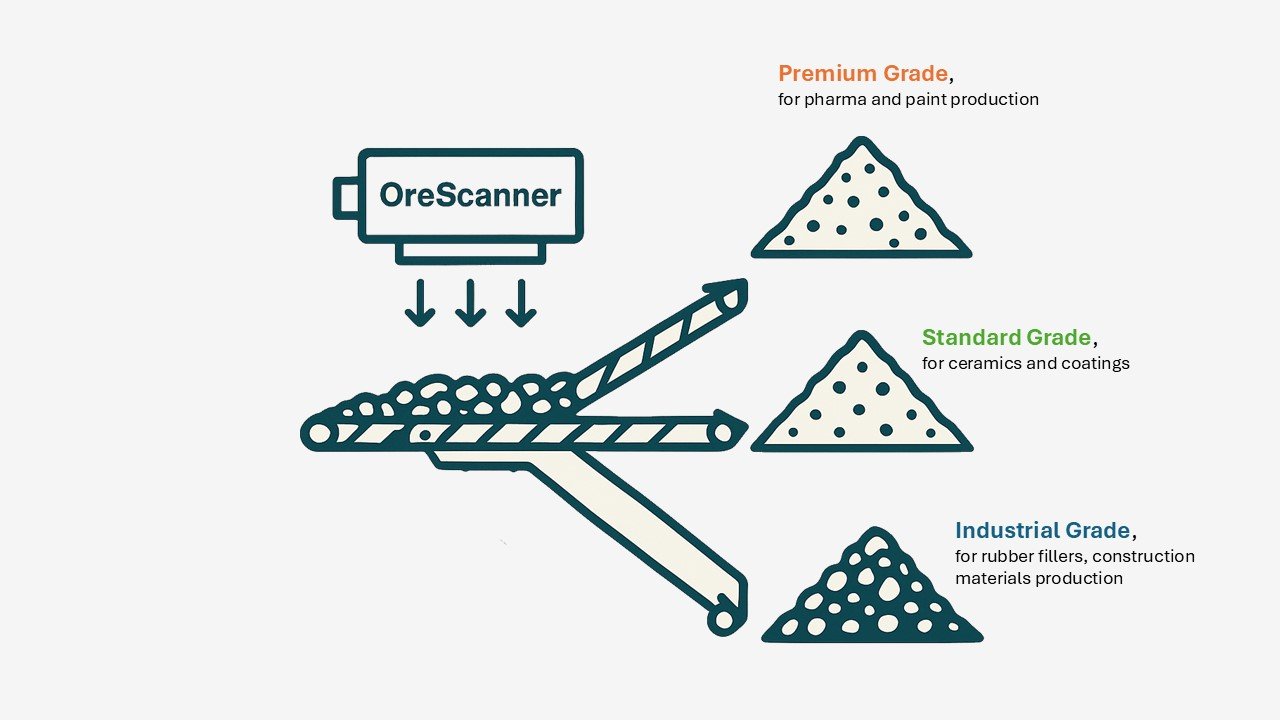
- Grade-Based Routing: Real-time quality visibility allows for grade-based routing decisions, ensuring high-purity ore is directed to premium product lines.
- Energy Efficiency: By avoiding unnecessary processing of subgrade material, energy consumption is reduced.
- Maximized Revenue: Ensures that each batch of ore is utilized in the most profitable manner.
The Result
Implementing OreScanner in talc mining and processing enables:
- Fewer quality complaints or rejections
- Better control over brightness and purity
- Reduced processing waste and energy cost
Discover the Difference — Explore Our Customer Case Studies